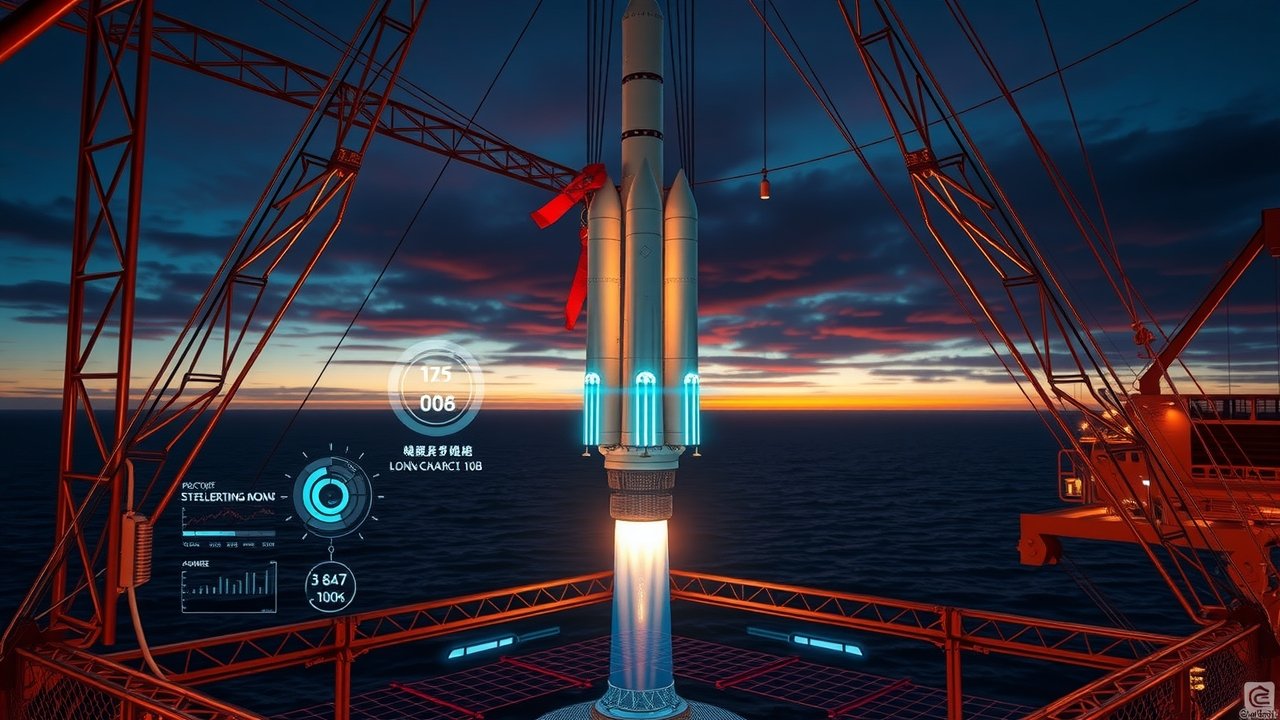
China just caught a giant rocket with a net on a barge, and SpaceX should worry
While some billionaires are busy arguing on social media, engineers in Asia just quietly rewrote the orbital playbook. We are officially entering a wild new era of the space race where old-school landing legs are suddenly looking like ancient history.
The 70-meter beast known as the Long March 10B roared off the Wenchang launchpad, packing 760 tons of raw weight and a mission to eventually deploy a massive satellite internet constellation. Instead of the usual fireworks we expect from debut orbital tests, the first stage separated smoothly, plummeted back through the atmosphere, and perfectly docked itself onto a marine barge in the South China Sea.
While SpaceX popularized the iconic landing legs that look like giant metallic spiders, the state-run CALT academy decided those legs were way too heavy and retro. Instead, they slapped heavy-duty hooks onto the rocket's body and built a giant, high-tech rope trap on the recovery ship. The rocket basically flew right into a massive metal cradle, allowing tension cables to grab it mid-air and absorb the kinetic energy like a very expensive, very dangerous hammock.
This mechanical acrobatics routine was powered by seven YF-100 engines burning kerosene and liquid oxygen, which can throttle down deeply to perform the ultimate breaking burn. Up top, the second stage utilized a vacuum-rated YF-219 engine running on liquid methane, chosen specifically because methane doesn't leave filthy soot deposits, making the whole stack incredibly easy to wash and reuse.
This successful catch marks the first time anyone outside of the US has pulled off a vertical orbital rocket recovery, and doing it on the very first attempt is an absolute statistical anomaly. The recovered booster is already heading back to port for a quick checkup, with the engineers aiming to launch this exact same metal tube back into space before the end of the year.
These recovered pieces are the literal stepping stones for the upcoming super-heavy Long March 10, which will chain 21 of these engines together at launch. This system is the backbone of the aggressive plan to land astronauts on the Moon before 2030, directly challenging the American timeline.
The space race is no longer a monopoly of Silicon Valley hype-men. With the Eastern superpower skipping the trial-and-error phase entirely to catch rockets in giant steel webs, the orbital playground just got incredibly crowded. The Moon is starting to look like a very tight neighborhood, and the lease agreements are going to be chaotic.
Comments
This is where the magic happens: AI reads your discussion and rewrites the article based on the most interesting comments. Each strong comment adds points to the meter below. Once the meter is full, the article updates live — no page reload needed.