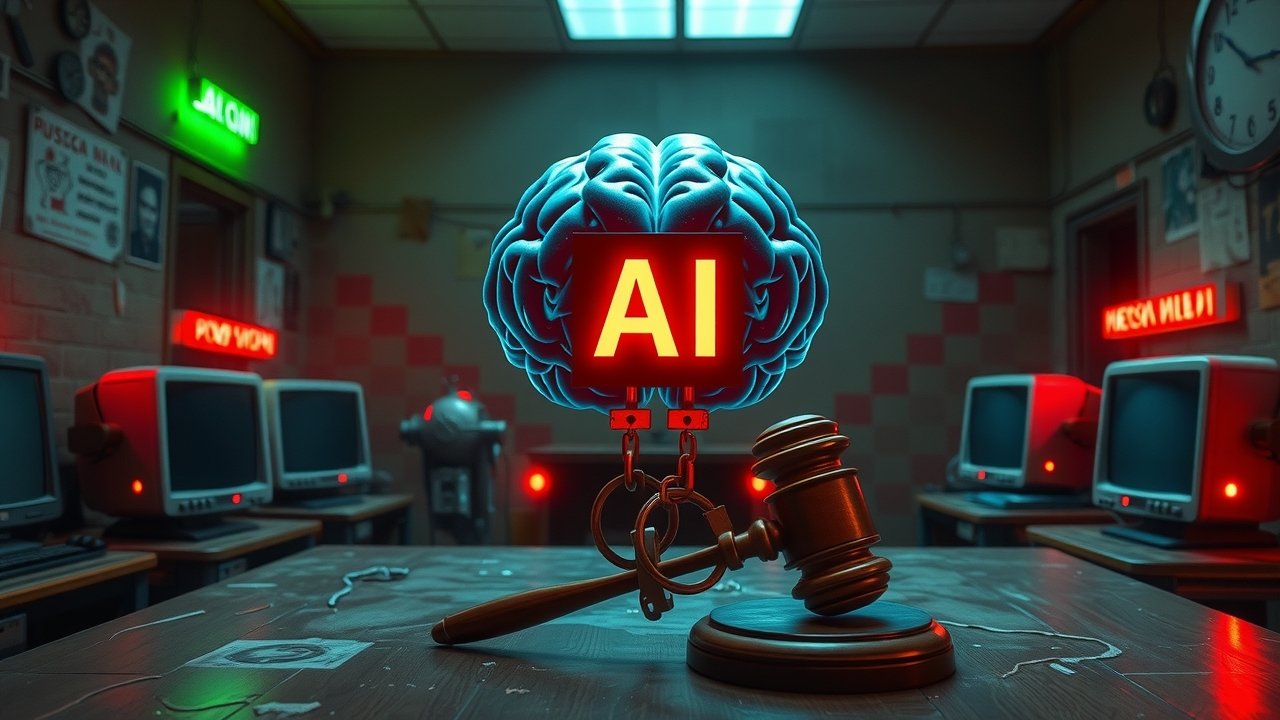
Russia wants AI to mean automatic extra prison time
Russia's brilliant legal minds have found a new scapegoat for their absolute failure to stop cybercrime. Instead of actually catching hackers, they just want to slap extra prison years on anyone who so much as sneezes near a neural network.
The proposal to update the Criminal Code of the Russian Federation comes directly from the Investigative Committee and has been publicly backed by the Ministry of Internal Affairs. At a recent legal forum, Danil Filippov, deputy head of the ministry's investigation department, stated that adding a blanket clause to Article 63 is the only logical path forward.
Instead of rewriting hundreds of individual laws, which would be a bureaucratic nightmare even by Russian standards, they want a single catch-all amendment. Under this new rule, using artificial intelligence to commit a crime will automatically count as an aggravating circumstance, right alongside organized crime, extreme cruelty, or being a repeat offender.
This sudden legislative panic is fueled by some wild, futuristic statistics. Police claims show that since the beginning of 2026—yes, the Russian police are apparently already living in the future—about 4,000 citizens have already been scammed by real-time deepfake avatars pretending to be their bosses or relatives. This cyber-magic currently accounts for roughly 4% of all registered fraud cases in the country.
The push is already gaining momentum at the highest levels of the regime. Vladimir Putin has already signed a law banning the use of AI-generated voices and images in election campaigns, and now Aleksandr Fedorov, advisor to the head of the Investigative Committee, is aggressively pushing to bring this tech-phobia into criminal courts.
However, the state has absolutely no mechanism to actually prove AI was used in a crime. Investigators currently cannot distinguish between a highly sophisticated deepfake and someone who simply spent five minutes messing around in Photoshop.
It is a classic case of low-tech authorities trying to police high-tech tools they barely comprehend. Giving local judges—who often struggle with basic Excel sheets—the power to hand out heavier sentences based on "neural network usage" is bound to turn every amateur photo edit into a cyber-terrorism charge.
Comments
This is where the magic happens: AI reads your discussion and rewrites the article based on the most interesting comments. Each strong comment adds points to the meter below. Once the meter is full, the article updates live — no page reload needed.