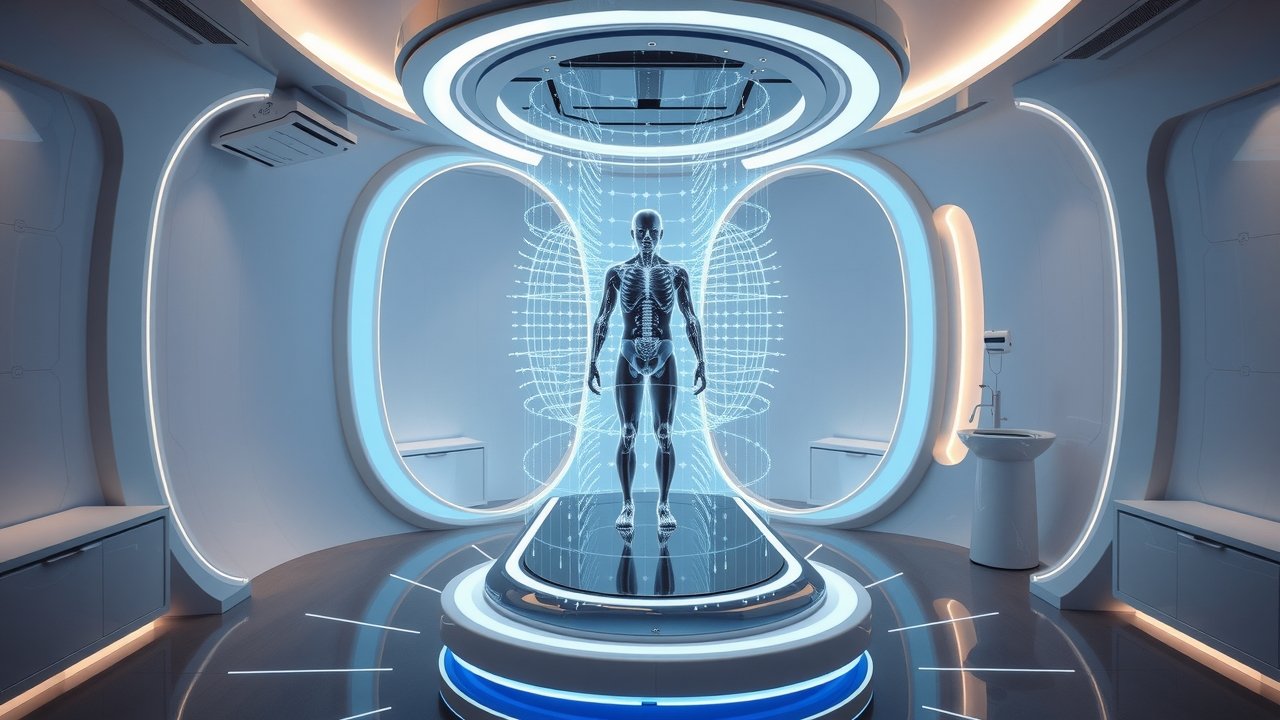
Midjourney Promises MRI-Level Body Scans in a Spa: What Could Go Wrong?
Midjourney just pivoted from making trippy AI art to hardware medicine, claiming a machine that scans your whole body in a minute. It is essentially an ultrasound-in-a-bath-tub, because who doesn't want their medical diagnostics served with a side of steam and sauna?
The company behind the viral image generator has launched Midjourney Medical, introducing a full-body ultrasound scanner that aims to rival MRI technology. The device works by having a user step onto a platform and submerge into a shallow pool, where underwater sensors track sound waves like a pod of dolphins. While the founder David Holz admits the current prototype takes about 20 minutes to process data, the ultimate goal is a 60-second scan that yields a complete 3D health map.
To build this, Midjourney secured a licensing deal with Butterfly Network, paying 15 million dollars upfront for their ultrasound-on-chip tech. By 2031, the company plans to deploy over 50,000 of these units globally, starting with an installation at their own Midjourney Spa in San Francisco in 2027. The business model frames medical imaging not as a clinical necessity, but as a casual accessory to a relaxing spa day.
The medical community is already raising eyebrows, as the device is currently classified as a wellness product to bypass FDA regulations. Critics point out that mass screening of asymptomatic people often leads to a cascade of false positives, causing unnecessary biopsies and patient anxiety for findings that are clinically irrelevant. Without any peer-reviewed clinical studies or independent verification of image quality, the company is betting heavily on the hope that if you make a diagnostic tool feel like a luxury treatment, nobody will notice the lack of a doctor in the loop.
Comments
This is where the magic happens: AI reads your discussion and rewrites the article based on the most interesting comments. Each strong comment adds points to the meter below. Once the meter is full, the article updates live — no page reload needed.