Meta’s new Muse Spark 1.1 beats GPT-5.5 in agent tasks for a ridiculous $1.25
Just three months after waking up from its Llama 4 coma, Meta drops a model that allegedly runs circles around OpenAI and Anthropic at a price so low it feels like a typo. Get ready for autonomous AI agents actually doing chores instead of just talking.
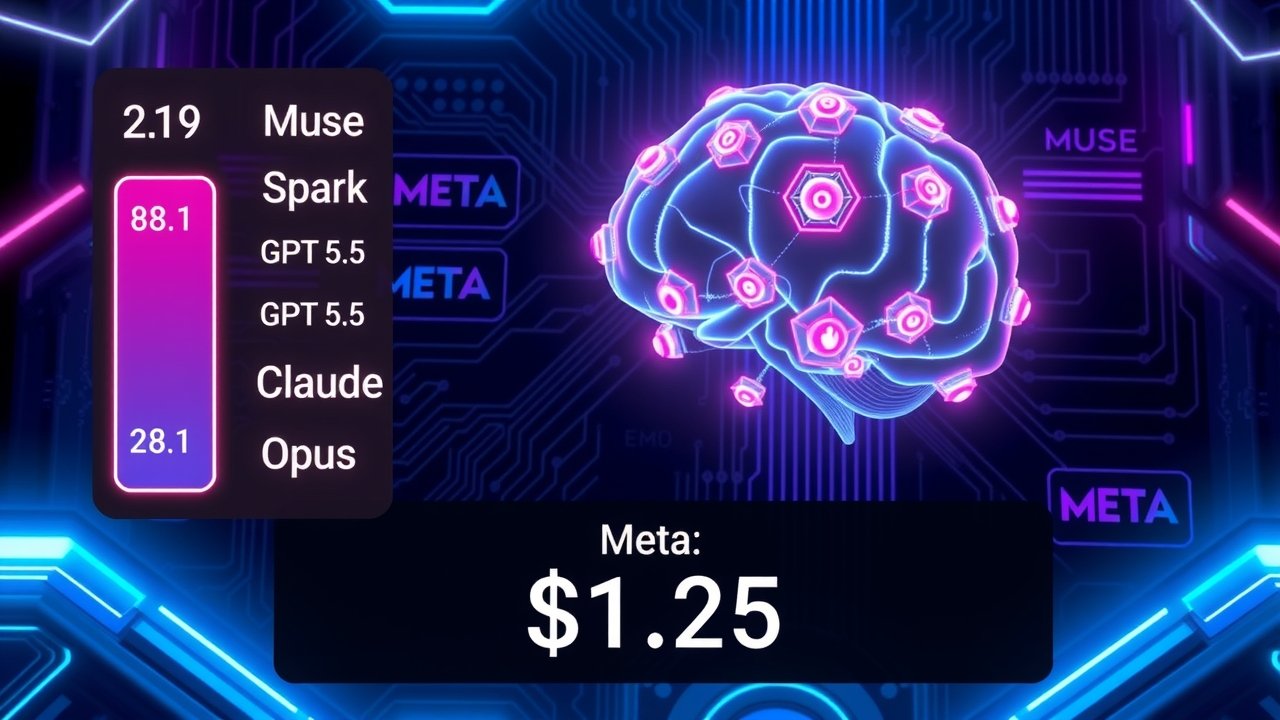
The engineering team at Meta Superintelligence Labs, led by Alexander Wang, launched Muse Spark 1.1 as a direct challenge to the AI hegemony. This new multimodal reasoning model is specifically engineered to operate as an autonomous agent, making decisions and executing workflows without human hand-holding. On the MCP Atlas benchmark, which evaluates how well an AI agent manipulates external software tools, the model scored 88.1 points, comfortably outperforming Claude Opus 4.8 at 82.2, Gemini 3.1 Pro at 78.2, and GPT-5.5 at 75.3.
This digital assistant does not just chat; it actively commands computer interfaces. The model's architecture allows it to control desktops, web browsers, and mobile operating systems, intelligently choosing whether to write a quick automation script or physically click buttons like a tired office intern. To prevent its virtual brain from melting during long tasks, the engine utilizes an active context-management system over a 1-million-token window, automatically compressing its history while preserving critical decision-making milestones.
When faced with massive engineering pipelines, the system acts as a chief coordinator, designing a plan of attack and delegating sub-tasks to parallel, specialized sub-agents. While its coding capabilities on SWE-Bench Pro reached 61.5 points—falling slightly behind Opus 4.8's 69.2 but still beating GPT-5.5's 58.6—its main appeal lies in its extreme cost efficiency.
The newly launched Meta Model API offers this model at $1.25 per million input tokens and $4.25 per million output tokens. Early enterprise partners like Replit, led by Amjad Masad, have already integrated the API, praising its ability to act as a fully realized foundation for automated software development.
While tech giants continue to promise artificial general intelligence in exchange for the GDP of a small country, open-ecosystem pressure is forcing raw performance prices straight to the floor. Releasing flagship-grade agent intelligence at pocket-change pricing essentially commoditizes the very brains of the future automation economy, leaving proprietary model hoarders with increasingly expensive, over-engineered paperweights.
Source: Meta AI
Comments
This is where the magic happens: AI reads your discussion and rewrites the article based on the most interesting comments. Each strong comment adds points to the meter below. Once the meter is full, the article updates live — no page reload needed.