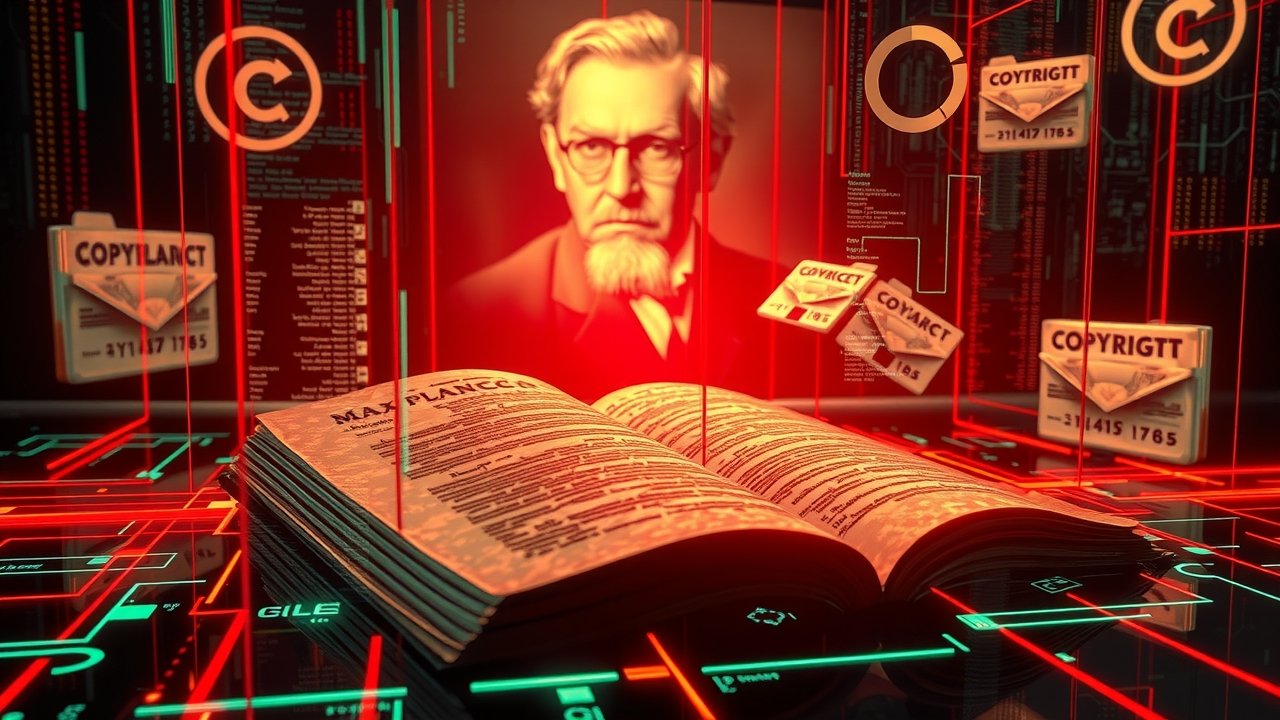
Springer Nature’s Bot Just Retracted a Nobel Prize Winner’s Work for Being 'Illegal'
In a delightful display of technological incompetence, an automated bot has successfully 'cancelled' Max Planck. It seems that even the laws of quantum mechanics are no match for a corporate algorithm that can't tell history from copyright infringement.
Decades after the death of Max Planck , his scientific legacy has found itself in the crosshairs of an automated content filter. Two research papers originally published in the 1940s were purged from the archives of The Science of Nature, with the publisher citing "copyright infringement" as the reason. One paper, a philosophical essay, was flagged because it appeared in multiple publications—a common practice in the pre-internet era when information didn't travel at the speed of light.
The second retraction is even more absurd. Max Planck had written a response to a critique by Alois Müller , resulting in both men publishing papers with the exact same title. The Springer Nature algorithm apparently decided that a shared title in 1940 was a modern-day case of plagiarism, ignoring the fact that the actual texts were completely different arguments. Historians Yves Gingras and Mahdi Khelfaoui pointed out that since Planck died in 1947, his works are long since public domain.
The cherry on top of this technological disaster is the business model. Springer Nature scrubbed the papers from the web but still lists the empty, "retracted" PDF files for sale at $39.95 each. When the journal’s editor-in-chief, Susanna Scarlata , attempted to fix the mess, she discovered the algorithm had acted entirely without human oversight, and the corporate parent company flatly refused to acknowledge the mistake.
This is the natural conclusion of automating academic integrity: a world where a mindless script holds more authority than a Nobel laureate. When historical truth is sacrificed at the altar of "automated copyright compliance," it is clear that the machines are no longer serving the researchers, but the researchers are serving the broken metrics of a digital storefront.
Source: Science.org
Comments
This is where the magic happens: AI reads your discussion and rewrites the article based on the most interesting comments. Each strong comment adds points to the meter below. Once the meter is full, the article updates live — no page reload needed.