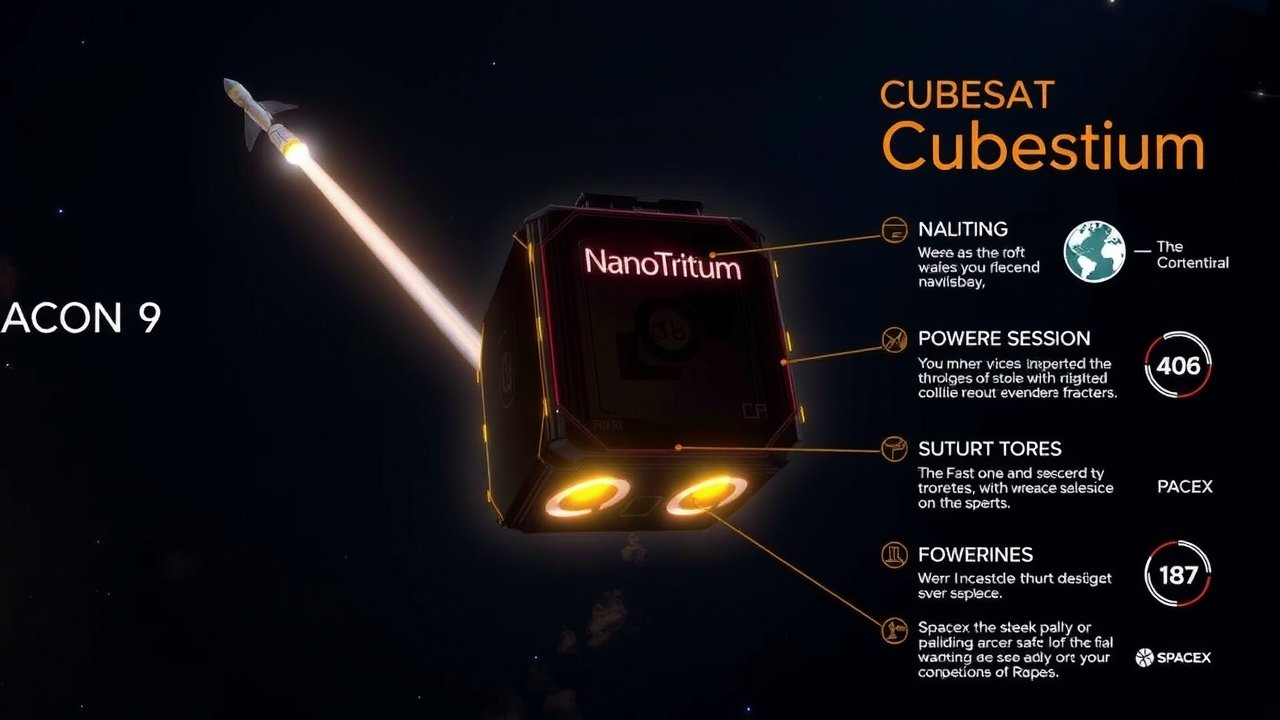
No Sun? No Problem: SpaceX Launches First Commercial Nuclear-Powered Satellite
Solar panels are so 2025. While everyone else is crying over clouds and battery degradation, some mad geniuses just shot a literal nuclear battery into space on a SpaceX rocket. Science fiction is officially happening, and it's powered by tritium.
The demonstration cubesat named BOHR, built by tech firm City Labs, hitchhiked to orbit aboard a Falcon 9 rocket during the Transporter-17 mission.
The satellite is testing a tiny, safe nuclear battery called NanoTritium, marking the first time a commercial spacecraft is running on nuclear decay instead of standard solar grids.
Because apparently, waiting for the Sun to shine behind the Earth's shadow is too mainstream for modern spacecraft. While standard lithium batteries inevitably die and turn into orbital junk, this radioactive bad boy generates constant juice by harvesting the slow decay of tritium into completely stable, non-radioactive helium-3. Think of it as a glowing, high-tech glow-stick that never goes dark and won't explode.
This isn't some rogue garage experiment either. The FAA gave its official greenlight, and heavy hitters like the U.S. Department of Defense, NASA, and the Air Force Research Laboratory are backing the mission. The nuclear battery is currently powering the main payload, while standard solar cells handle the basic satellite housekeeping just in case.
The Falcon 9 booster B1097 completed its eleventh successful flight, landing safely on the drone ship Of Course I Still Love You in the Pacific Ocean.
With the ambitious Artemis lunar program demanding constant power in the pitch-black shadows of the Moon, solar reliance is looking increasingly prehistoric. It seems the future of deep space exploration won't be powered by clean sunlight, but by safe, cozy, commercial nuclear decay—leaving green energy enthusiasts to argue whether radioactive space batteries count as eco-friendly.
Source: City Labs
Comments
This is where the magic happens: AI reads your discussion and rewrites the article based on the most interesting comments. Each strong comment adds points to the meter below. Once the meter is full, the article updates live — no page reload needed.